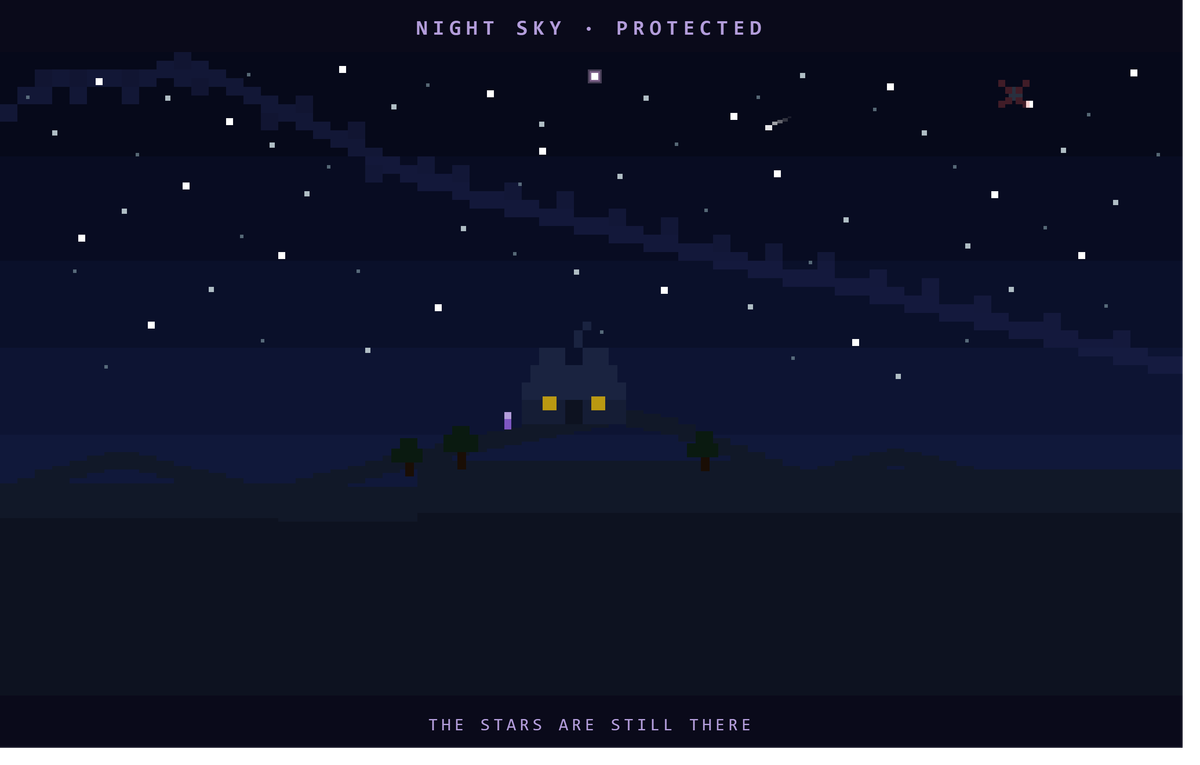
A proposed "space mirror" satellite meant to beam sunlight onto targeted swaths of Earth and turn night into day has been denied approval by the U.S. Federal Communications Commission — after the agency concluded, in what legal scholars are calling "an act of basic literacy," that blinding every telescope on the planet might not serve the public interest.
The satellite, called Eärendil-1 and built by the California-based startup Reflect Orbital, would have been the first of some 50,000 similar spacecraft the company hoped to launch by 2035. The FCC reviewed the proposal, read more than 1,800 public comments expressing concern about the project's impact on the night sky and Earth's orbital environment, and then — in a move that caused audible gasping in the hearing room — took the comments into account.
"We considered the public interest," said an FCC spokesperson, slowly, as though explaining the concept to someone hearing it for the first time. "Which, upon reflection, includes the public."
Reflect Orbital's proposition was to provide "sunlight on demand" for solar power plants, emergency search and rescue operations, and round-the-clock construction projects. Eärendil-1 would have deployed an 18-meter-wide steerable mirror to demonstrate that technological feat; anyone or anything in the path of its beam would have seen the satellite as a glaring dot shining up to four times brighter than a full moon. The FCC noted that looking directly at such a beam through a telescope could permanently damage eyes and sensors alike — a consequence the agency characterized, with admirable restraint, as "bad."
"We were initially inclined to approve it," one commissioner admitted on background, "and then someone on staff asked whether we'd considered the part where it blinds people, and we had to admit we had not fully weighed that variable."
Agency discovers its own jurisdiction, appears moved
In its written commentary, the FCC addressed the more than 1,800 objections it received and acknowledged that the optical effects of Reflect Orbital's plan — sky brightening, light pollution, disruption of astronomical observation — fell squarely within the scope of its public interest mandate, even if light itself is not a radio frequency.
"We recognize that 'it's technically not our problem' is not a regulatory philosophy," the commentary read. "It is, in fact, the opposite of one."
This interpretation was welcomed by Samantha Lawler, an associate professor of astronomy at the University of Regina in Saskatchewan, who said she experienced an unfamiliar sensation upon reading the decision, which she later identified as "hope."
"It shows that the regulatory framework for outer space, while full of gigantic holes, can occasionally be used by people who notice the holes and choose not to walk through them," Lawler said. "I had honestly prepared a very different statement."
Study reveals what everyone already suspected: 50,000 mirrors would be too many mirrors
The FCC's decision was informed by a study conducted by Olivier Hainaut, an astronomer at the European Southern Observatory, who used computer simulations to model the impact of Reflect Orbital's full 50,000-satellite fleet. The results were unambiguous: the global night sky would become three to four times brighter than it is today. Even the planet's darkest skies — remote deserts, mountaintop observatories, the places humanity goes specifically to look at the universe — would become about as bright as the sky above a suburban town.
"The FCC read our study," Hainaut said, pausing to let the full weight of that sentence settle. "They read it, and then they acted on what it said. I have been a scientist for thirty years and I am not sure this has happened before."
Hainaut noted that for many animals, the proposed brightening could disrupt circadian rhythms. For naked-eye stargazers, it would vastly limit what could be seen. For astronomers, it would make much of their observational work effectively impossible. The FCC, he said, appeared to have concluded that these were downsides — a determination he called "correct and also, somehow, brave."
"We astronomers are certainly not in favor of forbidding satellites," Hainaut added. "We just wanted someone, somewhere, to consider whether erasing the night sky is a thing we should do on purpose. And someone did. I need a moment."
Company responds with grace, decency, and a visible flinch
In a statement that industry analysts described as "startlingly reasonable," Reflect Orbital accepted the FCC's decision and announced it would work with regulators to develop a version of its technology that does not, as a primary feature, obliterate observational astronomy.
"At Reflect Orbital, we recognize that responsible deployment at scale requires clear rules," the company's spokesperson said. "We believe it is our responsibility to work alongside governments, scientists and regulators rather than ahead of them."
The spokesperson then paused before adding, as though the thought had only just occurred: "Ahead of them would have meant launching 50,000 mirrors into orbit while everyone was still figuring out if that was allowed. We can see how that might have been — suboptimal."
Congress briefed; astronomers invited into the room they'd been standing outside of
The American Astronomical Society, which published a petition in March urging the FCC to deny the proposal, praised the decision and said it planned to work with Congress to establish clearer regulatory oversight for the environmental and astronomical impact of satellite constellations.
Roohi Dalal, the AAS's deputy director for public policy, noted that more than 14,500 satellites are now active in orbit, with proposals existing for more than 1.7 million additional spacecraft, including SpaceX's Starlink megaconstellation and its proposed space-based data centers.
"The FCC talked about the public interest of fostering American technological innovation in space," Dalal said. "And I would just emphasize that scientific research and astronomical research has actually been at the forefront of American innovation and global leadership for decades. That innovation they're looking to foster can't come at the cost of imperiling scientific research."
She delivered this statement — which she had clearly prepared for a very different context — with the slightly bewildered cadence of someone whose argument had been accepted on the first try.
International community takes notes, considers trying it
Betty Kioko, a space lawyer who serves as the European Southern Observatory's representative in the United Nations Committee on the Peaceful Uses of Outer Space, said the FCC's decision could spur similar regulatory action internationally.
This May, the national science academies of the G7 countries released a statement recommending the creation of a governing body with a broad focus on regulating traffic management, orbital carrying capacity, and environmental and astronomical impact, along with a new international treaty explicitly dealing with the effects of satellite constellations.
"I think we're going to see a more concerted effort at an international level to address these challenges," Kioko said, "because there's now a precedent for what it looks like when a single state considers the impact of its decisions on the international community. It looks like this. It looks like reading a study and saying 'no.'"
The G7 academies' statement also recommended, with the understated desperation of institutions that have been shouting into a void, that future regulations account for "the positive and negative effects of satellite constellations" — the inclusion of the word "negative" representing, by the standards of multilateral scientific diplomacy, a primal scream.
Regulatory gap acknowledged; gap briefly embarrassed
The FCC's decision has also drawn attention to the fact that the United States currently has no regulatory body other than the FCC that upholds the 1967 Outer Space Treaty before harm is done. The treaty names signing members responsible for the actions of spacecraft launched from their territory and requires states to avoid "harmful contamination" of space.
Several legal experts noted that replacing the night sky with a permanent suburban twilight would seem to qualify as "harmful contamination," a phrase the treaty's authors apparently included on the assumption that future generations would be able to parse a two-word phrase.
"We don't want to fix the problem," Hainaut said. "We want to avoid the problem. And for the first time, someone avoided it."
He was quiet for a long moment.
"The stars," he added, "are still there."
At press time, they were.
The REAL bad news: https://www.scientificamerican.com/article/u-s-approval-of-giant-space-mirror-satellite-alarms-astronomers/